Atheism
The Stranger (Albert Camus Edition)Atheism is not merely a doctrine that Meursault mentions in The Stranger; it is the position through which he resists the demand that his life, his mother’s death, and his crime be translated into religious meaning. At first his disbelief appears passive and untheorized. By the end, under sentence of death, it has become an active refusal of repentance, divine judgment, and the hope of an afterlife, while also enabling him to confront death without pretending that it can be redeemed.
Definition and Early Appearance
Meursault’s atheism is first presented through his uncertainty about his mother’s religious life. When the warden of The Home for Aged Persons tells him that arrangements have been made for a Church burial because his mother’s friends believed she wished to be buried according to Church rites, Meursault thanks him but privately observes that his mother, though not a professed atheist, had never given religion any thought. The distinction is important: religious observance exists around her death as an institutional arrangement, while belief itself seems absent from the intimate history Meursault shares with her.
This early scene also establishes the social pressure surrounding disbelief. The warden treats a Church funeral as a practical matter, one more element of the Home’s arrangements, but Meursault cannot connect the ceremony to any conviction he remembers in his mother. His response neither attacks religion nor seeks to defend his own position. Atheism initially appears as indifference: religion is simply not part of the explanatory world through which he understands himself or his mother.
Religious Authority and the Criminal Case
The examining magistrate transforms Meursault’s private disbelief into a matter of public judgment. During an interrogation, the magistrate suddenly takes a silver crucifix from a file cabinet and waves it before Meursault while insisting that even the worst sinner can receive God’s forgiveness if he repents. The crucifix becomes more than a devotional object: it is an instrument by which the magistrate tries to place Meursault’s crime inside a structure of sin, repentance, and salvation.
Meursault answers that he does not believe in God. The magistrate reacts as though this answer were logically and morally impossible. He insists that all men believe in God, including those who reject Him, and declares that his own life would lose meaning if he ever doubted this. The exchange reveals a conflict between two kinds of certainty. The magistrate treats religious belief as the foundation of meaning and moral intelligibility; Meursault treats the magistrate’s demand for belief as unrelated to the concrete question before them. The magistrate is especially baffled by the fact that Meursault waited before firing a second time, whereas Meursault regards that detail as minor compared with the magistrate’s religious interpretation of his character.
The courtroom later extends this moralization beyond the interrogation room. The Judge asks why Meursault sent his mother to an institution and whether the separation caused distress. The Prosecutor questions whether Meursault returned to the stream intending to kill the Arab and dismisses his answer that the return was a matter of chance. Witnesses emphasize that Meursault did not want to see his mother’s body, shed tears, or linger at her grave, and that he smoked cigarettes, slept, and drank café au lait beside the coffin. These facts are treated as evidence of a defective moral nature rather than as separate from the question of religious belief. Atheism therefore becomes entangled with the court’s broader demand that grief, guilt, and respectability take recognizable forms.
Imprisonment, Death, and the Refusal of Consolation
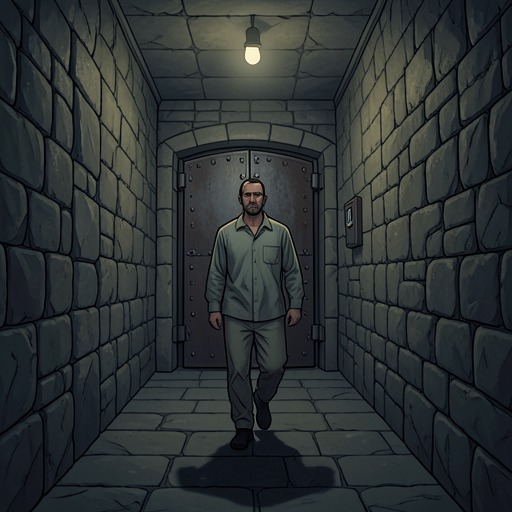
In prison, atheism becomes inseparable from the awareness of death. Meursault waits through nights for the possibility that jailers will come at dawn, listening for footsteps and treating each morning without them as another twenty-four hours of respite. He repeatedly considers whether his appeal will be dismissed or succeed, but even the possibility of legal escape cannot remove the fact that death is inevitable. His reasoning strips away the supposed difference between dying at thirty and dying at seventy: in either case, death must eventually be faced, and the world will continue after the individual is gone.
His thoughts about the guillotine sharpen this refusal of religious or civic consolation. He imagines a condemned prisoner escaping the “implacable machinery of justice” at the last moment, not because such an escape would provide a meaningful future, but because the possibility of one lucky break would offer a final throw against an otherwise fixed sequence of events. The court’s verdict appears strangely contingent to him: it is delivered at one time rather than another, by men whose ordinary lives continue outside the judgment, and in the name of an entity as vague as the French people. Yet once pronounced, the verdict becomes physically effective, as solid as the prison wall against which he rests. Atheism leaves him without an afterlife in which this contradiction might be resolved; it also prevents him from disguising institutional force as cosmic justice.
Meursault’s final confrontation with religious authority comes when he refuses, for the third time, to see the prison chaplain. When the chaplain asks why he will not receive him, Meursault explains that he does not believe in God and sees no point in troubling his head over the question. He confirms that he believes death means dying outright and that nothing remains afterward. The chaplain regards this as a condition that would make life unbearable, but Meursault does not accept the premise that life requires the promise of continuation in order to have value.
The chaplain then separates human justice from divine justice. He says that Meursault may be acquitted on appeal yet remain burdened by guilt, because earthly judgment cannot absolve sin. Meursault rejects the distinction: he is conscious of having committed a criminal offense and is already paying its penalty, but he is not conscious of any sin and does not accept that anyone has the right to demand more of him. The exchange exposes the opposing moral languages. The chaplain speaks of salvation and a debt before God; Meursault speaks of an offense, a sentence, and the limits of what can be required from a condemned man.
Revolt Against the Afterlife
The chaplain’s persistence turns Meursault’s nonbelief into open revolt. He acknowledges that he has sometimes wished for an afterlife, but places that wish beside ordinary desires such as wealth, physical ability, or a better-shaped mouth. The wish does not prove faith; it is merely one human possibility among others. When asked what an afterlife would mean, Meursault answers that he would want only a life in which he could remember his earthly life, then tells the chaplain that he has had enough of his company.
He is angered further when the chaplain asks why Meursault has not called him “Father.” Meursault rejects the title, saying that the priest is not his father and is instead on the side of the people who have condemned him. When the chaplain places a hand on his shoulder and says that he is on Meursault’s side because Meursault’s heart is hardened, the attempted spiritual reassurance becomes another form of accusation. Meursault seizes the chaplain by the neckband of his cassock and erupts in anger, rejecting the priest’s prayers and declaring that it would be better to burn than to disappear.
This outburst is not a conversion to an opposing creed. It is a rejection of every certainty that claims authority over his final experience. Meursault insists that he is more certain of his present life and approaching death than the chaplain is of his religious assurances. His certainty is limited, bodily, and temporal: he knows that he has lived in a particular way, made particular choices, and will die. Atheism here functions less as a systematic argument than as a refusal to exchange those facts for a consoling narrative imposed from outside.
Final Recognition and Thematic Significance
After the chaplain leaves, Meursault becomes calm. During the night he hears a steamer’s siren and, for one of the first times in months, thinks of his mother. He now understands why she had taken on a fiancé and played at beginning again in the Home: with death near, she may have felt like someone on the brink of freedom. This recognition revises the meaning of her final years without appealing to religious redemption. Her renewed attachment and his own final awareness belong to the same condition of mortality, in which a new beginning remains imaginable even when life is ending.
Meursault then feels ready to start life over again. His anger has washed him clean of hope in the ordinary sense, and he opens himself to the “benign indifference of the universe.” The phrase does not make the universe benevolent in a religious sense; it names a world that neither condemns nor rescues him and that shares his lack of guaranteed purpose. In this final state, atheism becomes a form of lucidity rather than mere apathy. Meursault accepts that no divine order will explain his death, no afterlife will preserve him, and no religious ritual can make his life conform to society’s expectations.
The final wish that a large crowd greet his execution with howls of execration completes the movement from passive disbelief to deliberate confrontation. He no longer asks for mercy, metaphysical justification, or escape through hope. He wants the world to meet him without disguise, as he has learned to meet it. Atheism thus supplies the novel’s decisive counterpoint to the magistrate’s crucifix, the chaplain’s prayers, and the court’s moralized reading of grief: it leaves Meursault alone before death, but within that isolation he recognizes both his happiness and his kinship with an indifferent universe.